


Whole Home Renovation Timeline: What to Expect in Calgary
A whole home renovation in Calgary is a 6 to 9 month project end to end. That’s the honest range.
We’ve heard plenty of homeowners get quoted “3 to 4 months” by contractors who want to win the job. The reality is that a serious whole home renovation has six phases, each with its own work and its own waiting, and skipping or compressing any of them is how budgets blow up and walls get torn down twice.
This guide walks through what each phase actually involves, how long it really takes, and what tends to push timelines out. If you’re planning a whole home reno this year or next, this is the framework to set expectations against.
Why renovation timelines vary so much
Two whole home renovations of identical scope can finish months apart. The variables that drive that gap:
- Whether design is finalized before demolition starts. Mid-build changes typically cost two to three times what the same change would have cost on paper.
- Whether the contractor uses a design-build or design-bid-build model. Hand-off between separate design and construction teams is where weeks disappear.
- Permit timing. Calgary permits can take anywhere from 2 to 8 weeks depending on the season and the scope.
- Material lead times. Custom cabinets, imported tile, specialty plumbing — none of these arrive overnight.
- Trade availability. Spring and early summer are Calgary’s busiest renovation season. Trades book up 2-4 months out.
Knowing where these variables hit your specific project is the difference between a realistic timeline and an optimistic one.
Phase 1: Discovery and design (4-6 weeks)
The first phase is where the project actually gets shaped. Most homeowners underestimate it because nothing visible is happening yet — but this is the phase that determines whether the build phase runs smoothly or chaotically.
What happens:
- Initial consultation. Goals, scope, budget framework.
- Site measure and existing conditions documentation.
- Conceptual design — layouts, room flow, key design decisions.
- Material and finish selections — cabinetry, countertops, plumbing, lighting, flooring, tile.
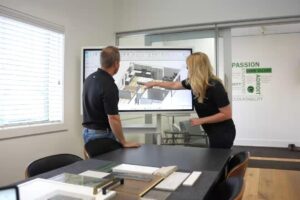
- 3D rendering — walk-throughs of the proposed space before construction.
- Final drawings — every detail spec’d so the build team can execute without guessing.
What pushes this phase:
- Indecision on big-picture layout. Most timelines slip here.
- Late material selections — every selection needs to be locked before drawings are final.
- Changes to scope mid-design (a kitchen reno turning into a kitchen-plus-living-room reno halfway through).
How to keep it on track:
- Set decision deadlines at the start. Treat them as serious.
- Lean on 3D rendering to make decisions you can’t see on a flat plan.
- Get all decision-makers in the same room for selections.
We cover our full design process — including 3D rendering at the rough concept stage — if you want a deeper view of what this phase looks like inside a design-build firm.
Phase 2: Permits and pre-construction (2-4 weeks)
With drawings finalized, permits get pulled and pre-construction logistics get nailed down.
What happens:
- Building permit submission to the City of Calgary.
- Trade scheduling — locking in plumbers, electricians, framers, drywall, painters.
- Material orders placed (especially long-lead items: cabinets, custom millwork, tile from non-stock).
- Project schedule built out by phase.
- Final cost reconciliation against the design budget.
- Site protection plan: flooring covers, dust containment, alt-kitchen setup.
What pushes this phase:
- City of Calgary permit review times — typically 2-4 weeks, sometimes longer in spring/summer rush.
- Trade availability — peak season delays can push start dates by 4-6 weeks.
- Long-lead materials — custom cabinetry often runs 8-12 weeks from order. Some imported tile runs longer.
How to keep it on track:
- Submit permits the moment drawings are final. Don’t wait.
- Order long-lead materials before this phase ends.
- Lock the start date with trades early, even if it’s 6-10 weeks out.
Phase 3: Demolition (1-2 weeks)
The fun part for most homeowners — and the most visible. Existing finishes come out, walls open up (or come down), and the bones of the house are exposed.
What happens:
- Site protection installed. Floors covered, doorways sealed, dust barriers up.
- Demolition. Cabinets, drywall, flooring, fixtures — removed.
- Waste disposal. Multiple bin loads, typically.
- Structural inspection of newly exposed framing.
- Surprises documented. Old wiring, surprise plumbing, vermiculite insulation, knob-and-tube — all things that occasionally turn up.
What pushes this phase:
- Discovery items. If something needs remediation before construction can continue (asbestos, knob-and-tube, structural issues), the timeline pauses.
- Layout changes after seeing the bones. Sometimes the design changes once walls are open. Avoid this by trusting the 3D renderings, but it does happen.
How to keep it on track:
- Have a contingency budget (10-15%) and a clear process for change orders.
- Resist the urge to redesign based on what demo reveals — unless it’s structurally necessary.
Phase 4: Build and rough-ins (8-12 weeks)
The longest phase. This is where the new structure goes in, mechanical systems run, and the renovation starts taking shape.
What happens:
- Framing — any structural changes, new walls, openings closed in.
- Rough plumbing — drains, supply lines, vents.
- Rough electrical — wiring, panel updates, lighting circuits.
- HVAC — duct adjustments, ventilation upgrades.
- Insulation and vapour barrier.
- Drywall — hanging, taping, mudding, sanding (multiple coats).
- Mid-phase inspections by the City of Calgary (framing, plumbing, electrical).
What pushes this phase:
- Inspection scheduling delays.
- Mid-build design changes (this is the most expensive place to change anything — every change cascades).
- Material delays for cabinets, doors, or trim that arrive later than expected.
How to keep it on track:
- Make decisions early and stick with them.
- Trust the project manager to flag issues as they emerge.
- Don’t add scope mid-build. Note it for the next renovation.
Phase 5: Finishes (4-6 weeks)
The home starts looking like the renderings. This phase is fast in terms of visible progress but it’s the most detail-intensive.
What happens:
- Flooring installation — hardwood, tile, LVP, carpet.
- Cabinetry install. Boxes go in, then doors and drawer fronts, then hardware.
- Countertop templating, fabrication, install.
- Tile work — backsplashes, bathroom surrounds.
- Paint — primer, finish coats, touch-ups.
- Trim and millwork — baseboards, casings, crown, built-ins.
- Plumbing fixtures — faucets, toilets, showerheads.
- Light fixtures and switches.
- Final electrical trim — outlets, plates, dimmers.
- Appliance install.
What pushes this phase:
- Cabinet delivery issues (damaged on arrival, wrong panels, hardware shortages).
- Specialty trade scheduling — high-end tile setters book out.
- Final selections that weren’t fully locked in design.
How to keep it on track:
- All selections finalized before this phase, period.
- Get cabinet install scheduled at the start of the phase, not the end.
- Build a punch list as you go — don’t save everything for the end.
Phase 6: Walkthrough and handoff (1-2 weeks)
The renovation isn’t finished until both sides agree it’s finished. This phase exists for that.
What happens:
- Pre-walkthrough deep clean. Job site dust is real.
- Project manager walkthrough — internal punch list generated.
- Client walkthrough — homeowner punch list generated.
- Punch list items addressed (touch-ups, missing trim, fixture adjustments).
- Final inspection by the City of Calgary.
- Warranty documents transferred.
- Maintenance handoff. How to care for the finishes, when to call the contractor.
- Keys back. Project officially closed.
What pushes this phase:
- Long punch lists from a project that wasn’t well-managed earlier.
- Final inspection timing.
- Touchup paint dry times.
How to keep it on track:
- Build the punch list as you go through Phase 5.
- Schedule the City inspection the moment Phase 5 wraps.
Why design-build firms run faster timelines
The single biggest predictor of a renovation timeline holding is whether the design team and the construction team are the same team.
In a traditional model, you hire a designer, get drawings, then bid the project to general contractors. The contractor reads the drawings, finds questions, sends them back to the designer, waits, gets answers, starts. Then halfway through construction, a detail comes up that the designer didn’t fully spec. More waiting.
In a design-build model, the same firm handles both. The designer who drew the cabinet detail is in the same office as the project manager who’s installing it. Questions get answered in hours, not weeks. Decisions made in design are decisions the construction team already understands. The handoff doesn’t exist because there’s no handoff.
For a whole home renovation specifically, this matters. Hand-off friction in a 6-month build adds up to weeks of slipped schedule. Removing it is one of the most effective ways to keep a timeline tight.
The realistic Calgary whole home renovation timeline
Putting it all together for a representative whole home renovation in Calgary in 2026:
| Phase | Duration |
|---|---|
| Discovery + design | 4-6 weeks |
| Permits + pre-construction | 2-4 weeks |
| Demolition | 1-2 weeks |
| Build + rough-ins | 8-12 weeks |
| Finishes | 4-6 weeks |
| Walkthrough + handoff | 1-2 weeks |
| Total | 20-32 weeks (5-8 months) |
If a contractor is quoting you substantially faster, ask which phase they’re compressing and why. If substantially slower, ask which phase is the constraint and how they’re managing it. Both questions are reasonable.
When to start planning
If you’re targeting a finish date, work backwards.
- Want to be in the new home by Christmas? Start design in April or early May.
- Want to enjoy the renovation through summer? Start design in October or November of the prior year.
- Want to be done before Stampede? Start the prior November at the latest.
Calgary’s busiest renovation season runs April through September. Spring consultations are most contested. If you’re planning for next year’s spring start, having your design phase wrapped by late winter is the sweet spot.
You can also read our companion blog on choosing a renovation contractor in Calgary for the vetting framework we’d recommend running every contractor through before you commit.
Frequently asked questions
How long does a whole home renovation actually take in Calgary?
Realistically, 5 to 8 months end to end. Design takes 4-6 weeks. Permits and pre-construction take 2-4 weeks. Demolition takes 1-2 weeks. Build and rough-ins take 8-12 weeks. Finishes take 4-6 weeks. Walkthrough and handoff take 1-2 weeks. Faster than 5 months usually means corners cut. Longer than 8 months usually means scope creep or trade availability issues.
What’s the longest part of a whole home renovation?
Build and rough-ins. 8-12 weeks of framing, mechanical systems, drywall, and inspections. It’s also the phase with the most variables — mid-build changes here cascade through everything that follows.
Can I live in my home during a whole home renovation?
Most homeowners can’t. The dust, the noise, and the loss of kitchen and bathroom function make daily life impractical. Some choose to live elsewhere for the entire build. Others rent short-term. Talk to your contractor about an alt-kitchen setup early if you’re planning to stay.
What’s the difference between design-build and traditional renovation contracting?
Traditional model: separate designer and contractor, two contracts, hand-off in between. Design-build: one firm, one contract, design and construction handled by the same team. Design-build tends to reduce timeline slippage and miscommunication, which matters most on whole home projects.
Will my whole home renovation actually finish on time?
If design is fully finalized before demolition, materials are ordered early, the contractor uses a design-build model, and scope doesn’t change mid-build — yes, timelines hold. The vast majority of renovation delays come from mid-stream decisions that should have been made earlier.
Ready to start planning?
If you’re considering a whole home renovation in Calgary in 2026 or 2027, the most useful next step is a free consultation. We’ll walk through your scope, your timeline goals, and what’s realistic.
You can also browse our recent whole home projects or read what past clients say about going through the process.